About Deepak Maharjan

This author has not yet filled in any details.
So far Deepak Maharjan has created 90 blog entries.

US Global Leadership: Where Are We Today?

July  8, 2020

Richard Silver

Since WWII all American Presidents have exercised global leadership. This has largely been welcomed by our friends and allies; it has provided predictability, peace and prosperity. Where we have departed from this tradition, such as with the invasion of Iraq, our reputation has suffered. Now, many of the world’s expectations for U.S. leadership have been met with surprise, from our pandemic response to a threatened withdrawal of 10,000 troops from Germany. This discussion will consider how the world sees America and consider the policy implications for the future.

Richard Silver retired from the U.S. Foreign Service in 2017 as the U.S Embassy, Bucharest spokesperson after also serving in Japan, Pakistan, Colombia and India) as a public diplomacy officer. Previously, he was the Executive Director of the Japan Society of Northern California; Chair, Japan Team, Federal Reserve Bank of San Francisco; and a Senior Attorney, U.S. Treasury Department.

During his time at Treasury, Richard was detailed to the U.S. Attorney’s Office as a white collar crime prosecutor as well as to the Japanese Finance Ministry as a Mike Mansfield Fellow advising on Japan’s Big Bang legal and financial sector reforms. He currently serves on the Santa Fe Council on International Relations’ Board. His primary foreign language is Japanese although he studied all of the languages in the countries in which he served.

This is the fourth in our summer series Summer with SFWAF: Hot Weather, Hot Topics. We hope to offer two webinars a month normally held on a Wednesday from 11:00 am to 12:15 pm throughout summer 2020 on a variety of current international affairs topics to SFWAF members and friends.

We are using the Zoom Webinar Format. We will begin this and future webinars with a short orientation. We encourage you to use Hand Raise and Talk function more than Q&A to preserve the discussion format that is the character of the Forum. It will be possible for people to join at 10:50 to familiarize yourselves with the webinar format in advance of the program.

You are invited to a Zoom webinar.
When: Jul 8, 2020 11:00 AM Mountain Time (US and Canada)
Topic: US Global Leadership: Where Are We Today?

Register in advance for this webinar: Click Here

After registering, you will receive a confirmation email containing information about joining the webinar. Please keep that email where you can easily access it on July 8.

If you do not receive the confirmation email or are not familiar with Zoom and need technical assistance, please contact Krista Peterson prior to the webinar at krispete@rocketmail.com. She will also monitor this email at the beginning of the webinar in case you are having difficulty connecting, but may not be able to respond right away. President Patricia Kushlis, Board members Krista Peterson and Steve Kerchoff will be co-hosting and moderating the session.

US Global Leadership: Where Are We Today?2020-07-10T05:30:59-07:00

Russia and Ukraine’s Tangled Relationship

March 2, 2020

Dr. James West and Krista Peterson

The Russia-Ukraine relationship begins in the 9th century with the establishment of Kievan-Rus, a trading center established on the banks of the Dnipro River as a loose confederation of Slavic, Nordic and Finnish tribes under the leadership of the Viking King Rurik.  It lasted until the 13th century. Kievan-Rus adopted Christian Orthodoxy in 988 AD and over time became dominated by Slavs, in particular Russians.  Over the intervening centuries, multiple myths and stories bolstering territorial claims and counter-claims arose, the capital was moved to Moscow after the 13th century Mongol invasions and a single Christian Orthodox church divided along linguistic lines.  Although the Russians long claimed Ukraine its own and still consider Ukrainians their “little brothers,” in reality much of the territory was later ruled by a succession of European powers.Ukraine first established a short-lived independent state in 1917 but was then incorporated into the Soviet Union.  The Republic became independent in 1991 after the fall of the Soviet Union but its sovereignty continues to be challenged time and again by Moscow.  What are the myths that haunt this entangled relationship, why is Ukraine still so important to Moscow and what role does the US play in protecting Ukrainian independence?

Please note:  this program will be divided into two parts with buffet lunch served between.  It will begin with a 40 minute talk by Professor and Russian historian James West on the history and myths which envelope the Russian view of Ukraine. Post-lunch will consist of a panel and discussion with Dr. West and Krista Peterson on the weight of history on Ukraine today, its geopolitical significance and Ukraine’s importance not just to Russia but also the US and Europe.

Dr. James L. West, a specialist in pre-revolutionary Russian society, holds a PhD in history from Princeton University. He taught at the European University in St Petersburg, Russia from 2015-17, the sole remaining private university in the Russian Federation which was closed in 2017 by the Russian government in its drive to eliminate western liberal thought in the country.

He was a professor of history and humanities at Middlebury College (1995-2011) and professor of history at Trinity College, Hartford, Connecticut (1971-1995). During his academic career, he was the recipient of several prestigious US government grants to conduct and publish research in and on the Soviet Union which resulted in: Between Tsar and People (1991) and, Merchant Moscow, (1998) Princeton University Press and republished in Russia in 2008 which he edited.

In addition to Russian history, West has taught courses on the interplay of culture, society, intellectual thought and politics in Russia and Central Europe. He spoke at SFWAF’s first symposium “A Window on Russia” in 2006 on “Old Merchants and New Modernism: Moscow, Modern and Post-Modern 1905-2005 and at our 2019 symposium on “The Fascist Temptation” and our 2018 symposium on “Up Off Our Knees:  The Search for a Usable Past for Russia’s Resurgence.”

Krista Peterson received a degree in radio/television/film from Northwestern University in 1993 but it was a presentation by the US Department of State during her college years that led her to join the Foreign Service. She arrived in Tegucigalpa, Honduras—her first foreign country other than Canada and Mexico—in September 1998 to live and work. Hurricane Mitch devasted Honduras two weeks later, which made for a very interesting two years in the consular section.

After Russian language training she arrived in Ukraine about one month before the terrorist attack in the US on September 11, 2001. Not long after that she consolidated many US agencies spread out across Kyiv and administrative functions housed in shipping containers on the Embassy grounds into two floors of a leased building. She has been an administrative specialist ever since and has worked for several different for profit businesses and nonprofit and educational organizations in Española and Santa Fe.

The SFWAF Program will be in the:  The SFCC Board Room (#223) which is in the West Wing (Administration building) of the Santa Fe Community College.

(more…)

Russia and Ukraine’s Tangled Relationship2020-03-27T12:06:38-07:00

The Critical Importance of Science to US Government Operations and Policy Making: Examples and Current Dangers

February 6, 2020

Karl Braithwaite, Ed Hildebrand, Arvid Lundy and Cheryl Rofer

While it’s true that scientific research has permeated much of what the federal government has done over the years, is it still important? If so, why?  In a recent New York Times article entitled “Science Under Attack: How Trump is Sidelining Scientists and Their Work,” reporters Brad Plumer and Coral Davenport outline the current state of science, scientists and scientific research being conducted at the federal level.  Plumer and Davenport present – at best – a mixed picture.  A few agencies or programs are being allowed to continue as in previous administrations but others are being gutted, severely restricted or redirected in what they can or can’t do and fund or not fund.  What does this mean for America’s scientific cutting edge and for effective policy development and conduct of government programs?

Karl Braithwaite is a specialist in the relationship between science and government; a former Director of Government Relations for Sandia and Senior Manager for Los Alamos National Laboratories having dealt with national security issues, environment and energy topics, and science and technology policy issues over the years retiring from public service after 49 years; and Dean of the Muskie School of Public Service at the University of Southern Maine. Currently a leader in the Rio Grande Chapter of the Sierra Club, his PhD in political science is from the University of Wisconsin.

Ed Hildebrand has multidisciplinary experience in the biosciences and in national and international science and technology policy analysis. After earning a Ph.D. in biophysics from the Pennsylvania State University, he joined the Los Alamos National Laboratory where his research focused on the international human genome project. While at LANL he also served in postings to the Foreign Service as Science Attaché at the U.S. Embassy in London and to the White House Office of Science and Technology Policy. More recently, Ed was a science and engineering analyst with a not for profit national and homeland security contractor. He is currently a member of the Santa Fe World Affairs Forum Board.

Arvid Lundy has extensive experience in nuclear export controls, nuclear proliferation intelligence, electronic instrumentation design, and clinical medical physics. Arvid spent thirty one years at Los Alamos National Laboratory as project engineer, group leader, and program manager. His career included over 100 foreign trips for the US government on nuclear issues, especially international nuclear export control. He is Vice President of the Santa Fe World Affairs Forum.

Cheryl Rofer was a chemistat the Los Alamos National Laboratory for 35 years. She now writes scientific and political commentary for the web publications Nuclear Diner and Balloon Juice. She regularly provides background information on nuclear topics to reporters and has been quoted in the New York Times, Washington Post, and Vox. Her work at Los Alamos included projects in fossil fuels, laser development, and the nuclear fuel cycle and has worked on environmental remediation at Los Alamos and in Estonia and Kazakhstan. She is past president of the Los Alamos Committee on Arms Control and International Security and a founding member of SFWAF. She has published in scientific and political science journals and edited a book. She holds an A.B. from Ripon College and an M.S. from the University of California at Berkeley. She has spoken to SFWAF on several previous occasions, most recently on the Iran Nuclear Agreement.

The SFWAF Program will be in the:  The SFCC Board Room (#223) which is in the West Wing (Administration building) of the Santa Fe Community College.
The Critical Importance of Science to US Government Operations and Policy Making: Examples and Current Dangers2020-01-19T10:02:19-07:00

Greece on the Front Line: The Refugees Keep Coming

December 3, 2019

Jane Abbott

Download Power Point Presentation Here !

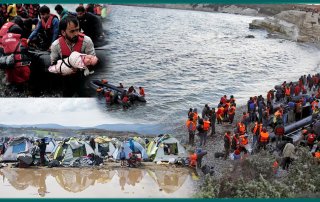
Since 2015, desperate refugees mostly from the Middle East and a few from West Africa, have been flooding the Eastern Greek islands of Kos, Samos, Lesbos, Leros, and Chios. The conditions on these islands, especially on Samos, where six times the number that can be accommodated are living in squalor and dangerous conditions, are bleak.

The EU made an agreement with Turkey in March of 2016, offering to pay Turkey to keep refugees in that country. However, few refugees want or are willing to stay in Turkey. Today, refugees try leaving Turkey multiple times, sailing across a three-mile stretch in precarious dinghies, in the hope that they can reach Greece and therefore apply for asylum. A Doctors without Borders spokesperson calls Greece, particularly the Greek islands, a “dumping ground” that has created a refugee emergency. In addition, the more people who try to cross from Turkey to Greece, the more deaths there are in the process.

Jane Abbott’s talk will center on her personal experience with refugees from the Vial Camp on Chios where she spent five weeks working for the NGO CESRT (the Chios Eastern Shore Response Team) which is allied with the German NGO Open Arms. She will explain how volunteers are used there and why Chios, although crowded with refugees and constantly struggling to help them, uses CESRT as a model for how to help those in need. In the past six months, the numbers at Vial have quadrupled, so caring for refugees becomes more and more challenging.

Jane Abbott earned her bachelor’s degree at the American College in Greece (Deree College) in literature and then a master’s degree at the University of Denver in comparative literature while also earning a teacher’s certificate. After teaching at the United States International University for a year, she joined the US Peace Corps teaching in a remote village in Nepal which could only be reached by several days’ walking. The next year, Abbott taught at the University of Nepal in Kathmandu and assisted with writing the Peace Corps Nepali language manual. Abbott lived with her family in Nepal for seven years, working as a teacher and consultant for Peace Corps and USIS.

For the next two years, Abbott lived in Honiara, the Solomon Islands and consulted in Kiribati. She ran training programs in education and business and evaluated posts in the South Pacific for the Peace Corps.

Returning to the US, Abbott taught literature and integrated humanities at various community colleges in Colorado. Simultaneously, she earned her Ph.D. in community college leadership. Subsequently, she worked as a dean in a community college in Colorado with 18,000 students especially with international students.

Abbott has a particular interest in international micro credit projects for women. She was a consultant through Colorado State University for WID (Women In Development) in Nepal and studied a women’s support NGO while on a Mosal Grant. Her project for a Fulbright-Hays Group Study Abroad grant then addressed this topic in Paraguay. Two subsequent Fulbrights in Thailand and Germany supplemented this specialty.

While working at community colleges throughout her career, Abbott developed study abroad cultural programs for adults. She has taken multiple study groups to Nepal, Turkey, and especially to Greece where she has returned many times.

Abbott has worked as a volunteer on many projects. Recently this has included women from Gaza in occupied Palestine. Because of her special interest and experience in working with women in challenging situations, she chose to go to the island of Chios in the spring of 2019. Her presentation today addresses her personal experience while there and how she used her skills and experience to help men, women, and children at the camp. She is an SFWAF Board Member.

(more…)

Greece on the Front Line: The Refugees Keep Coming2020-03-17T17:26:37-07:00

South Asia: The Next Nuclear Tinderbox?

November 7, 2019

Ankit Panda

India and Pakistan have fought four wars since their independence, including one after each broke out as a nuclear weapons power in 1998. A little more than 20 years ago, the two countries became the first nuclear-armed neighbors to fight a protracted conflict. In February 2019, after a terrorist attack in Indian-administered Kashmir, India became the first nuclear-armed country to use conventional airpower against its nuclear-armed neighbor. In August, the Indian government, after winning a historic electoral mandate in May, moved to abrogate the autonomy of the Indian state of Jammu and Kashmir. Kashmir remains at the center of broader disputes between India and Pakistan. Three of their four wars since 1947 were fought over that territory, which today remains highly militarized-a tinder box susceptible to be lit at any time.

In this context, what are the risks of a serious conflict in South Asia today between these two nuclear-armed neighbors? 21 years since their nuclear breakout, how have India and Pakistan operationalized their nuclear forces? Finally, amid Asia’s broader shifting geopolitics, how might the United States play a role in managing nuclear risks in the region?

Ankit-Pand

Ankit Panda is an award-winning American writer, analyst, and researcher specializing in international security, defense, geopolitics, and economics. His work has appeared in a range of publications, including the New York Times, Foreign Affairs, the Diplomat, the Atlantic, the Daily Beast, Politico Magazine, and War on the Rocks. He is currently a senior editor at the Diplomat, where he writes daily on security, geopolitics, and economics in the Asia-Pacific region and hosts a popular podcast. He is also an adjunct senior fellow at the Federation of American Scientists, where his work focuses on nuclear and conventional force developments in Asia, deterrence, and nuclear strategy.

Panda has additionally published scholarly research in journals including the Washington Quarterly, the Bulletin of the Atomic Scientists, and India Review. He is additionally a contributor to the International Institute on Strategic Studies’ Asia-Pacific Regional Security Assessment and Strategic Survey. Panda is also a consultant for a number of governments, international institutions, and corporations. He is a frequent participant in Track-2 and Track-1.5 dialogues in Asia, Europe, and North America. Panda is a graduate of the Woodrow Wilson School of Public and International Affairs at Princeton University. He lives in New York City and tweets at @nktpnd.  His forthcoming book, Kim Jong Un and the Bomb: Survival and Deterrence in North Korea, published by Hurst Publisher will be available in 2020.

The SFWAF Program will be in the:  The SFCC Board Room (#223) which is in the West Wing (Administration building) of the Santa Fe Community College.
South Asia: The Next Nuclear Tinderbox?2019-10-04T19:51:33-07:00

Illicit Trade: A Complex Web Of Criminals, State Sponsors And Opportunists

October 8, 2019

Suzanne Hayden

lllegal trade (trafficking) taints every country. It weaves countries together unwitting alliances through the efforts of unscrupulous individuals, criminal groups and state sponsors: preying upon weaknesses of infrastructures and legislation, promoting greed and corruption and ultimately affecting financial systems, reputations and economic stability, it is difficult to adequately calculate its harm to the economy, global security, the environment and the human toll. A closer look at the world of human, wildlife, tobacco and weapons trafficking illustrates the changing nature of organized crime and the impact such trafficking has on our stability and security.

Suzanne Hayden

Suzanne Hayden spent over 30 years as a US and International prosecutor. She was a senior prosecutor for the Department of Justice and a trial attorney at the International Criminal Tribunal for the Former Yugoslavia where she started the first UN financial intelligence unit to follow the money of Slobodan Milosevic and supervised one of the earliest global stolen assets investigations against a sitting State’s leader. She was the DOJ legal advisor in Russia and Turkey and drafted anti-money laundering, terrorist finance and asset forfeiture legislation at the request of over 25 countries. Ms. Hayden served as the US Department of Justice’s (DOJ) first national security coordinator and represented the DOJ in the Financial Action Task Force (FATF), the global standard setter for antimony laundering and terrorist financing and.

During her career, Ms. Hayden served as a senior advisor for the US Intelligence Community, the US Department of Justice, the US Department of the Treasury Office of Technical Assistance, the United Nations Office on Drugs and Crime and the International Anti-Corruption Academy in Austria. She is on the Board of Trustees of the UN Interregional Crime and Justice Research Institute and sits on two advisory boards for illicit trade and anti-corruption. Ms. Hayden is currently the legal strategist for International Wildlife Trust, an NGO formed to build prosecutable cases against organized crime groups whose wild life criminal activities have thus far remained insulated and untouchable. Ms. Hayden continues to follow her passion for Native American issues and is working on a strategy to address the US tragedy of murdered and missing Native American women and girls through investigation, advocacy and legislation.

The SFWAF Program will be in the:  The SFCC Board Room (#223) which is in the West Wing (Administration building) of the Santa Fe Community College.
Illicit Trade: A Complex Web Of Criminals, State Sponsors And Opportunists2019-09-18T22:29:37-07:00
Load More Posts