
The Santa Fe World Affairs Forum aims to broaden and deepen understanding of world affairs through small, interactive, professionally led sessions on international issues for a membership of informed individuals.
Programs and Webinars
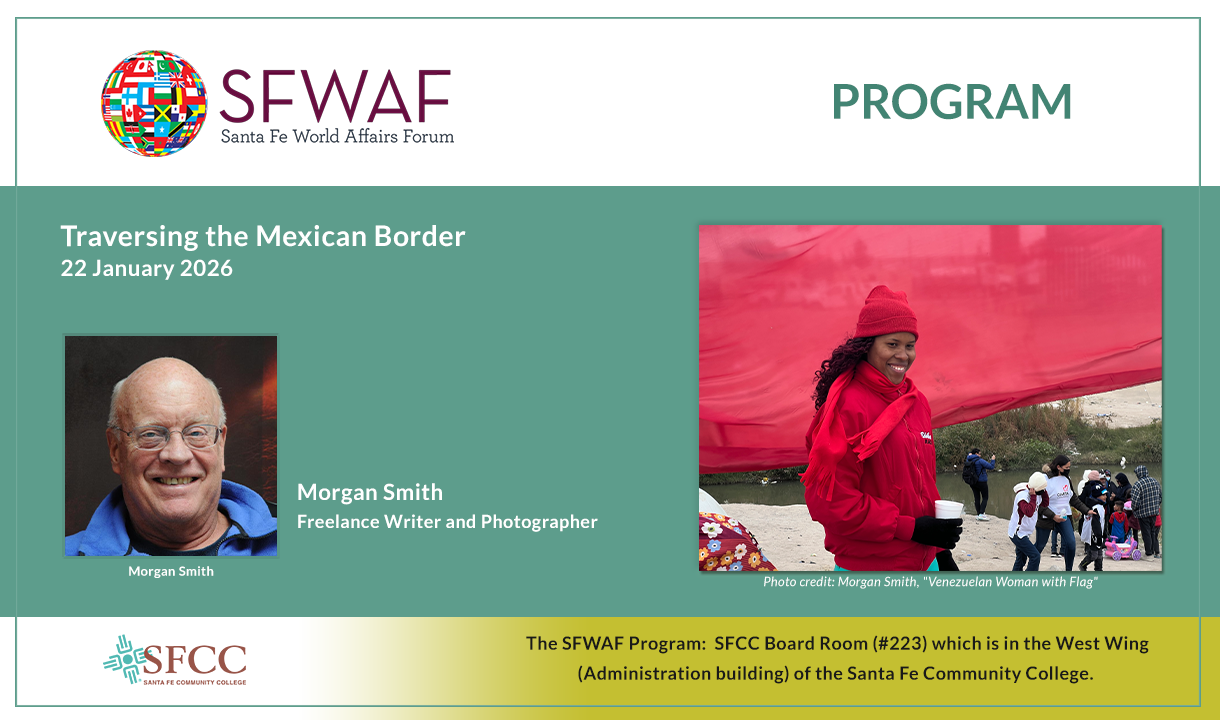
Traversing the Mexican Border
Thursday, January 22, 2026 from 12:00 noon – 2 pm
Morgan Smith
For decades the US has attracted migrants from around the world, but especially numerous are those who have crossed, or attempted to cross, the southern border from Mexico. US immigration policies have fluctuated but as migration increased, laws and their enforcement have tightened making it more difficult for asylum seekers and economic migrants to immigrate to the US through Mexico. Who are these migrants? Where do they come from? Why? Has the migrant flow been stemmed by the Trump administration policies? What are the implications in the US and elsewhere? How does this fit into the larger picture of US-Mexican relations? What happens to those refused entry? What do the migrants need most? What humanitarian groups are the most active on the border? How do asylum courts fit into the picture? Is CBP the only agency patrolling the border?
Morgan Smith is a freelance writer and photographer who has been working with organizations and individuals in Juárez, Anapra and Palomas, Mexico as well as El Paso, Texas and Deming, New Mexico for the past 15 years on programs and activities involved in assisting border communities deal with the migration flow along the US-Mexican border. He has written articles for the Denver Post, the Santa Fe New Mexican, El Paso Inc, the Albuquerque Journal, El Comercio do Colorado and Desert Exposure based on his experiences. He will illustrate this talk with photos he has taken during his trips.
A lawyer by training, Mr Smith served as a Volunteer mediator in Denver County Courts and Director of the Legal Clinic at El Centro Humanitario de Los Trabajadores. He was president of the American Society of Barcelona, Barcelona, Spain; Director of the Colorado International Trade Office, Executive Director of the Colorado Department of Local Affairs, Colorado Commissioner of Agriculture and Executive Director of Auraria Higher Education Center, Colorado’s largest campus.
UPCOMING SYMPOSIUM 2026
“Democracy in Danger”
April 30 – May 01, 2026
Democracy is founded on the idea that the ultimate power of governance lies in its people. In essence, power to govern flows upwards from the bottom not down from the top as is characteristic in autocratic regimes.
Democracy is dynamic. It can adjust to ever-changing environments and societal differences. US democracy is one of the oldest in today’s world, but it is also just one of many forms that have been tried since democracy’s origins in 6th century BCE Athens. Some have succeeded and others failed. Ultimately, all democratic governments provide legal structures. Some do so through written constitutions. Others rely on a set of agreed-upon laws that are underpinned by the values of liberty, independence, free speech, justice and fair play for all and yes, even the pursuit of happiness.
US democracy has changed substantially since it was introduced in the Declaration of Independence in 1776 and the US Constitution in 1789. Both are amazingly concise and revolutionary documents for their time that set out a framework designed to unite 13 disparate, quarreling, multiethnic, multilinguistic and multireligious British colonies governed by a king. This new framework was created to mitigate against the over concentration of power in a single individual or group by dispersing it through a system of checks and balances – from federalism, three branches of government, free media and speech, to regular elections run in the states.
But what if those 17th century guardrails are breached? When threatened, is democracy resilient enough to resist? Is it worth fighting for? Can it be protected? If so, how? What are its strengths and weaknesses? Its basic elements? Is it still even the best way to govern? And how should this form of government look and operate in the future?
Much of US foreign policy since the end of the Cold War was based on the mantra that the spread of democracy worldwide helps guard against wars. In fact, the spread of democratic values has been at the foundation of US foreign policy since the end of WWII. The current international system itself – now under challenge – is also based on democratic principles and aspirations – derived from this 18th century US experiment.
Yet today the democratic form of government is under threat. Has democracy run its course? Or does power still rest with “we the people”? And if so, how best can this great experiment function in states and nations here at home and abroad in the twenty-first century?
This year’s symposium will address and try to answer these and other questions.
PAST SYMPOSIUM
“Democracy in the Time of Autocrats”

Democracy in the Time of Autocrats
To register for the 2025 Symposium, please email sfwaforum@outlook.com with names of registrants, days attending and whether paying by check to SFWAF and mailed to: The Santa Fe World Affairs Forum PO Box 31965, Santa Fe, New Mexico 87594. Or to by Paypal or credit card through our website at https://sfwaf.org/payment
April 10-11, 2025
Speakers
Gary A Grappo, US Ambassador (rtd) and currently Distinguished Fellow at the Center for Middle East Studies at the Korbel School of International Studies, University of Denver; CEO of Equilibrium Consulting.
Siegfried Hecker, former director of Los Alamos National Laboratory and current professor of practice at Texas A&M University and at the Middlebury Institute of International Studies, Monterey, CA;
Dr. Manuel Montoya, PhD, Associate Professor, University of New Mexico, Department of Economics. A member of the Council on Foreign Relations, he has delivered over 100 lectures on emerging markets and global conflict worldwide and is a recent recipient of UNM’s Presidential Teaching Fellowship, the university’s highest honor. He has also developed Vessels and Voids, a podcast, which he discusses the link between popular culture and development of global society.
Dr. Jody K Olsen, former Director and Deputy Director of the US Peace Corps and Peace Corps staff member and volunteer who currently co-chairs Women of Peace Corps Committee, chairs the Peace Corps Commemorative Foundation Park Advisory Committee and a member of the Maryland Governor’s Commission for Service and Volunteerism. Dr Olsen has also authored A Million Miles: My Peace Corps Journey which was published earlier this year.
Eric Rubin, US Ambassador (rtd) to Bulgaria and former president of the American Foreign Service Association; Summary
We live in stormy times. The heyday following Communism’s end in the Soviet Union and Eastern Europe is a faded memory. History has not ended as once prophesized – it has instead moved on to the rise of populist leaders and their autocratic control domestically and internationally. The democratic model which promised so much is under challenge throughout the globe.
Can democracy survive the onslaught of autocrats? Can civil society institutions prove to be democracy’s underlying strength? But will they hold, or will they too falter?
There is deepening concern that autocrats, often initially elected democratically, have used the levers of raw power to dominate mainstream and social media, subvert education, and control elections first to hobble and then effectively destroy democracy turning back the clock by sweeping away progress on desperately needed reforms – from action on climate change to gender and income inequality.
Moreover, do autocracies now seize the opportunity to attack their neighbors? Threaten nuclear holocaust unless they get their way, and destabilize the
international order that kept the peace throughout much of the world since the end of WWII?
How significant is the ripple effect of the seemingly sudden demise of the 40 year old Assad dynasty not just for Syria itself but also for the greater Middle East, Russia, Ukraine,