About Deepak Maharjan

This author has not yet filled in any details.
So far Deepak Maharjan has created 88 blog entries.

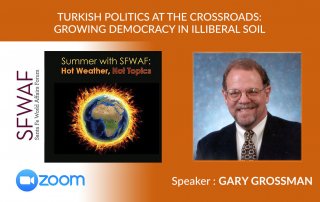
Turkish Politics at the Crossroads: Growing Democracy in Illiberal Soil

September 2, 2020

Dr. Gary M. Grossman

You are invited to join our September 2 Webinar: Turkish Politics at the Crossroads:  Growing Democracy in Illiberal Soil with Gary Grossman, Founding Associate Director of Academic Programs and Associate Professor in the School for the Future of Innovation in Society at Arizona State University.

The Republic of Turkey has been one of the most dynamic countries in the world since it was established in 1923, founded with the explicit purpose for its emergence as a modern, secular democracy.  Over the past century, progress toward this goal has occurred in fits and starts, democratically elected governments overthrown by the Turkish military four times. This presentation explores Turkey’s prospects for democracy in the 21st century in the context of its current government, the longest-lasting regime in its history.

Dr. Gary M. Grossman is the Founding Associate Director of Academic Programs and Associate Professor in the School for the Future of Innovation in Society at Arizona State University. He is also currently a Visiting Scientist with the United Nations Food and Agricultural Organization. He offers more than three decades of experience in the management of political, social, and technological development projects around the world with a particular focus on Turkey and Eurasia and was a Fulbright research scholar at the Middle East Technical University (METU) in Ankara.

This is the eighth and final webinar in our summer series Summer with SFWAF: Hot Weather, Hot Topics. We have offered two webinars a month held on Wednesday mornings from May 20 – September 2, 2020 for members and friends on a variety of current international affairs topics with foreign affairs experts in Washington, DC, New Mexico and Arizona. A list of our webinar speakers will be on our website sfwaf.org. Speaker bios are on the Speakers webpage. On September 16, 2020 we begin a three part 2020 election webinar series for SFWAF and LWV New Mexico members in conjunction with the League of Women Voters of Santa Fe County.

We are using the Zoom Webinar Format for this and our other programs. If you are interested in this program, please email sfwaforum@outlook.com for additional information.

Turkish Politics at the Crossroads: Growing Democracy in Illiberal Soil2020-08-30T00:42:58-07:00

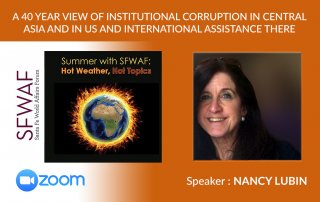
A 40 year view of institutional corruption in Central Asia and in US and International Assistance There

August  26, 2020

Nancy Lubin

You are invited to join our August 26 Webinar: “A 40 year view of institutional corruption in Central Asia and in US and International Assistance There” with Nancy Lubin, President, JNA Associates, Inc, a research and consulting firm on the former USSR, especially the Caucasus and Central Asia.

This talk will explore the challenges of US and international aid in addressing corruption — and deep-seated ‘institutional corruption’ –  in all sectors in formerly Soviet Central Asia and within the US, European and international assistance communities themselves.  Drawing from Lubin’s four decades of research, consulting and personal experience in this region, we will discuss the nature of ‘corruption’ in this part of the world; why some aid programs succeed; and why far too many assistance efforts have only exacerbated the very corruption they are committed to address and undermined their own objectives —  not only because of the difficulties of working in this part of the world, but because of institutional factors that pervade the foreign assistance community itself.

This is the seventh in our summer series Summer with SFWAF: Hot Weather, Hot Topics. We have been offering two webinars a month normally held on a Wednesday from 11:00 am to 12:15 pm Mountain Time throughout summer 2020 on a variety of current international affairs topics of concern to SFWAF members and friends.

We are using the Zoom Webinar Format for this and our other programs. If you are interested in this program, please email sfwaforum@outlook.com for additional information.

If you are not a member but interested in membership, please email sfwaforum@outlook.com for additional information.  

Because we are a 501(c)(3) organization, dues and contributions are tax deductible. 

For pricing and reservations, click here: https://sfwaf.org/payment/

A 40 year view of institutional corruption in Central Asia and in US and International Assistance There2020-08-24T18:36:43-07:00

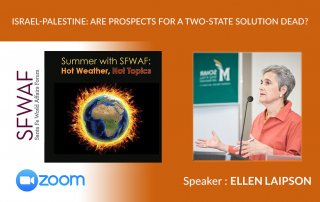
Israel-Palestine: Are Prospects for a Two-State Solution Dead?

August  12, 2020

Ellen Laipson

Welcome! You are invited to join our August 12 webinar: “Israel-Palestine: Are prospects for a two-state solution dead?” with Ellen Laipson, Director of the International Security program at the Schar School of Policy and Government at George Mason University.

This talk will address current developments and dynamics in the long saga and search for Arab-Israeli peace. While Israel improves its ties to major Arab states, the prospects for a successful resolution of the “Palestine question” remain low. We will discuss Israeli and Palestinian politics, the Trump Administration’s peace plan, and complicated debates over settlements, annexation, and questions of international law.

This is the sixth in our summer series Summer with SFWAF: Hot Weather, Hot Topics. We have been offering two webinars a month normally held on a Wednesday from 11:00 am to 12:15 pm Mountain Time throughout summer 2020 on a variety of current international affairs topics of concern to SFWAF members and friends.

We are using the Zoom Webinar Format for this and our other programs. If you are interested in this program, please email sfwaforum@outlook.com for additional information.

Israel-Palestine: Are Prospects for a Two-State Solution Dead?2020-08-06T19:01:59-07:00

A Zero-Based Foreign Policy?

July 29, 2020

Robert Hunter

Welcome! You are invited to join our July 29 webinar: “A Zero-Based Foreign Policy?” with US Ambassador (rtd) Robert Hunter.

Following the election in November, we will either continue with more of the same or have in January a new administration committed to doing things “differently” in foreign policy. For some of Biden’s advisors who speak in public, that means recapturing some of the practices that Trump has abandoned, notably a commitment to “liberal internationalism,” institutions, US “leadership,” solid relations with allies, and the like. But with the pandemic and its aftermath the United States (as well as others, of course) will find itself having to rethink and recalibrate at least some important aspects of its foreign policy. The Trump team – unless changed radically – has proven incapable of dealing with even this part of the agenda; but will Biden choose people able to do meet the daunting tasks either?

Perhaps this is a time when we should consider a “zero-based foreign policy,” starting with “things that we have to do for our security and well-being” that include guarding against “things that go bump in the night,” a foreign policy that pays more attention to our domestic situation than previously and one that includes a team capable of the strategic analysis needed to understand what is important to us and what is not and a foreign policy that ultimately faces the difficult, long term questions about America’s future role in the world.

Ambassador Robert Hunter served in the LBJ White House (education) at the time of the Great Society; was Ted Kennedy’s first foreign policy advisor; and was lead official on Europe and the Middle East on the Carter NSC staff. He was US ambassador to NATO (1993-1998) and was a principal architect and the lead negotiator of the post-Cold War transformation of NATO. He served on the Defense Policy Board and State’s International Security Advisory Board. He has taught at 5 universities; written 1200+ publications; taken part in 8 presidential campaigns; and written speeches for more serious candidates for president (12) than anyone else in US history. BA: Wesleyan University; PhD, London School of Economics.

This is the fifth in our summer series Summer with SFWAF: Hot Weather, Hot Topics. We hope to offer two webinars a month normally held on a Wednesday from 11:00 am to 12:15 pm Mountain Time throughout summer 2020 on a variety of current international affairs topics of concern to SFWAF members and friends.

We are using the Zoom Webinar Format. We will begin this and future webinars with a short orientation. We encourage you to use Hand Raise and Talk function more than Q&A to preserve the discussion format that is the character of the Forum. It will be possible for people to join at 10:50 to familiarize yourselves with the webinar format in advance of the program.

You are invited to a Zoom Webinar.
When: Jul 29, 2020 11:00 AM Mountain Time (US and Canada)
Topic: A Zero-Based Foreign Policy?

Register in advance for this webinar: Click Here

After registering, you will receive a confirmation email containing information about joining the webinar. Please keep that email where you can easily access it on  Jul 22.

If you do not receive the confirmation email or are not familiar with Zoom and need technical assistance, please contact Krista Peterson prior to the webinar at krispete@rocketmail.com. She will also monitor this email at the beginning of the webinar in case you are having difficulty connecting, but may not be able to respond right away. President Patricia Kushlis, Board members Krista Peterson and Steve Kerchoff will be co-hosting and moderating the session.

A Zero-Based Foreign Policy?2020-08-04T20:56:53-07:00

US Global Leadership: Where Are We Today?

July  8, 2020

Richard Silver

Since WWII all American Presidents have exercised global leadership. This has largely been welcomed by our friends and allies; it has provided predictability, peace and prosperity. Where we have departed from this tradition, such as with the invasion of Iraq, our reputation has suffered. Now, many of the world’s expectations for U.S. leadership have been met with surprise, from our pandemic response to a threatened withdrawal of 10,000 troops from Germany. This discussion will consider how the world sees America and consider the policy implications for the future.

Richard Silver retired from the U.S. Foreign Service in 2017 as the U.S Embassy, Bucharest spokesperson after also serving in Japan, Pakistan, Colombia and India) as a public diplomacy officer. Previously, he was the Executive Director of the Japan Society of Northern California; Chair, Japan Team, Federal Reserve Bank of San Francisco; and a Senior Attorney, U.S. Treasury Department.

During his time at Treasury, Richard was detailed to the U.S. Attorney’s Office as a white collar crime prosecutor as well as to the Japanese Finance Ministry as a Mike Mansfield Fellow advising on Japan’s Big Bang legal and financial sector reforms. He currently serves on the Santa Fe Council on International Relations’ Board. His primary foreign language is Japanese although he studied all of the languages in the countries in which he served.

This is the fourth in our summer series Summer with SFWAF: Hot Weather, Hot Topics. We hope to offer two webinars a month normally held on a Wednesday from 11:00 am to 12:15 pm throughout summer 2020 on a variety of current international affairs topics to SFWAF members and friends.

We are using the Zoom Webinar Format. We will begin this and future webinars with a short orientation. We encourage you to use Hand Raise and Talk function more than Q&A to preserve the discussion format that is the character of the Forum. It will be possible for people to join at 10:50 to familiarize yourselves with the webinar format in advance of the program.

You are invited to a Zoom webinar.
When: Jul 8, 2020 11:00 AM Mountain Time (US and Canada)
Topic: US Global Leadership: Where Are We Today?

Register in advance for this webinar: Click Here

After registering, you will receive a confirmation email containing information about joining the webinar. Please keep that email where you can easily access it on July 8.

If you do not receive the confirmation email or are not familiar with Zoom and need technical assistance, please contact Krista Peterson prior to the webinar at krispete@rocketmail.com. She will also monitor this email at the beginning of the webinar in case you are having difficulty connecting, but may not be able to respond right away. President Patricia Kushlis, Board members Krista Peterson and Steve Kerchoff will be co-hosting and moderating the session.
US Global Leadership: Where Are We Today?2020-07-10T05:30:59-07:00

Russia and Ukraine’s Tangled Relationship

March 2, 2020

Dr. James West and Krista Peterson

The Russia-Ukraine relationship begins in the 9th century with the establishment of Kievan-Rus, a trading center established on the banks of the Dnipro River as a loose confederation of Slavic, Nordic and Finnish tribes under the leadership of the Viking King Rurik.  It lasted until the 13th century. Kievan-Rus adopted Christian Orthodoxy in 988 AD and over time became dominated by Slavs, in particular Russians.  Over the intervening centuries, multiple myths and stories bolstering territorial claims and counter-claims arose, the capital was moved to Moscow after the 13th century Mongol invasions and a single Christian Orthodox church divided along linguistic lines.  Although the Russians long claimed Ukraine its own and still consider Ukrainians their “little brothers,” in reality much of the territory was later ruled by a succession of European powers.Ukraine first established a short-lived independent state in 1917 but was then incorporated into the Soviet Union.  The Republic became independent in 1991 after the fall of the Soviet Union but its sovereignty continues to be challenged time and again by Moscow.  What are the myths that haunt this entangled relationship, why is Ukraine still so important to Moscow and what role does the US play in protecting Ukrainian independence?

Please note:  this program will be divided into two parts with buffet lunch served between.  It will begin with a 40 minute talk by Professor and Russian historian James West on the history and myths which envelope the Russian view of Ukraine. Post-lunch will consist of a panel and discussion with Dr. West and Krista Peterson on the weight of history on Ukraine today, its geopolitical significance and Ukraine’s importance not just to Russia but also the US and Europe.

Dr. James L. West, a specialist in pre-revolutionary Russian society, holds a PhD in history from Princeton University. He taught at the European University in St Petersburg, Russia from 2015-17, the sole remaining private university in the Russian Federation which was closed in 2017 by the Russian government in its drive to eliminate western liberal thought in the country.

He was a professor of history and humanities at Middlebury College (1995-2011) and professor of history at Trinity College, Hartford, Connecticut (1971-1995). During his academic career, he was the recipient of several prestigious US government grants to conduct and publish research in and on the Soviet Union which resulted in: Between Tsar and People (1991) and, Merchant Moscow, (1998) Princeton University Press and republished in Russia in 2008 which he edited.

In addition to Russian history, West has taught courses on the interplay of culture, society, intellectual thought and politics in Russia and Central Europe. He spoke at SFWAF’s first symposium “A Window on Russia” in 2006 on “Old Merchants and New Modernism: Moscow, Modern and Post-Modern 1905-2005 and at our 2019 symposium on “The Fascist Temptation” and our 2018 symposium on “Up Off Our Knees:  The Search for a Usable Past for Russia’s Resurgence.”

Krista Peterson received a degree in radio/television/film from Northwestern University in 1993 but it was a presentation by the US Department of State during her college years that led her to join the Foreign Service. She arrived in Tegucigalpa, Honduras—her first foreign country other than Canada and Mexico—in September 1998 to live and work. Hurricane Mitch devasted Honduras two weeks later, which made for a very interesting two years in the consular section.

After Russian language training she arrived in Ukraine about one month before the terrorist attack in the US on September 11, 2001. Not long after that she consolidated many US agencies spread out across Kyiv and administrative functions housed in shipping containers on the Embassy grounds into two floors of a leased building. She has been an administrative specialist ever since and has worked for several different for profit businesses and nonprofit and educational organizations in Española and Santa Fe.

The SFWAF Program will be in the:  The SFCC Board Room (#223) which is in the West Wing (Administration building) of the Santa Fe Community College.

(more…)

Russia and Ukraine’s Tangled Relationship2020-03-27T12:06:38-07:00
Load More Programs