


Understanding Orban’s Hungary
SOLD OUT!!!
September 24, 2019
Dr. Deborah Cornelius
Hungary and the Fidesz regime of Viktor Orban have been much in the news in recent months, with criticism of the increasing centralization of power, control of the free press, and blows to academic freedom. Despite protests against widespread propaganda, increasing government control, limitations on freedom of academic research, during her most recent visit Dr. Cornelius found that much of the population still appear satisfied with the Fidesz government. They often praised the Orban regime and its accomplishments, although with a nonchalant acknowledgement of widespread corruption.
The fall of communism led to wild hopes in Central and Eastern Europe that the inhabitants would be able to join capitalist Western Europe and garner the benefits and standard of living associated with the West. Why has the early wild enthusiasm of 1990 disintegrated into disappointment and resentment? What accounts for the popularity of the Orban regime? Why is the opposition is so weak and fragmented? How have past governments failed the population, beginning with the rapid privatization after 1990? How has the refugee crisis of 2015 raised Orban’s popularity and increased criticism of the European Union? Does Orban represent the forefront of a rising tide of populist leaders in Eastern Europe, or his regime specific to the Hungarian situation?

Deborah S Cornelius is a historian and former professor at Rutgers, the State University. Her field of study is Central and Eastern Europe with a focus on Hungary and the lands of the former Hungarian Kingdom. She received her doctorate from Rutgers University, 1994, after a year of research in Hungary on a Fulbright Research Fellowship. Her MA is from Yale University, 1958 and BA from Connecticut College, 1956. She has taught at Franklin and Marshall College, the International School of Vienna, Austria, the American School,Tangier, Morocco, and Santa Fe Prep School. A leading US authority on Hungary, Cornelius most recently spent five weeks in Budapest studying the present state of the Hungarian regime.
Her publications concerning Hungary and the former kingdom include: Hungary in World War II: Caught in the Cauldron. Fordham University Press, 2011. Kutyaszorítóban: Magyarország és a II.világ háború. Rubicon-kőnvek. 2015. In Search of the Nation: the New Generation of Hungarian Youth in Czechoslovakia 1925-1934. 1925-1934. Columbia U. Press.1999.

 Dr. Randall Halle, The Klaus W. Jonas Professor of German Film and Cultural Studies and the Director of the Film and Media Studies Program at University of Pittsburgh, presents a lecture and screening of a film that addresses many of the urgent challenges facing societies across the globe.


 David Douglas leads non-profit organizations devoted to global clean drinking water, including the DC-based Global Water 2020 (

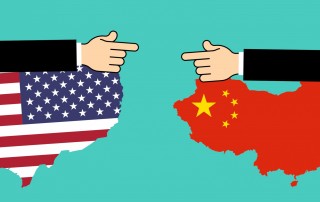
 In late September, the US-Chinese relationship took a turn for the worse in economic and national security terms. What happened? What is the state of play and what does this mean for US companies and other American businesses in terms of trade with our single largest trading partner? What is the state of the Chinese economy? Are the Trump administration’s tariff wars justified? Are they effective? Or has the relationship between these two giants soured so much that economic disagreements also affect national security and other interests?
 Hank Levine is a Senior Advisor with the Albright Stonebridge Group — a strategic advisory firm in Washington, DC. As a senior member of the firm’s multimillion-dollar China practice Mr. Levine helps international firms deepen their interactions with government and non-government entities in China and resolve business issues.