Values, Myths and Interests: Debating American Foreign Policy in an Unstable World

2019-05-01T14:20:34-07:00

April 9- 10, 2018

  Daniel Baer, Ambassador (rtd), Diplomat in Residence, Josef Korbel School of International Affairs, Denver University. US Ambassador to the Organization for Security and Cooperation in Europe (2013-17); Michael Battle, US Ambassador (rtd) to the African Union, academic, university provost, military chaplain and most recently Executive Vice President/Provost at the National Underground Railroad Freedom Center, Cincinnati, Ohio (Overview);  Ralph Begleiter, founding Director of the Center for Political Communication, University of Delaware and former world affairs correspondent, CNN (media and social media); Beatrice Camp, Senior Foreign Service Officer (rtd) and former US Consul General Shanghai (Chinese values); Laura S.H. Holgate, Ambassador (rtd), Senior Nonresident Fellow, Belfer Center for Science and International Affairs,Kennedy School of Government, Harvard University; Dr. Elizabeth Manak, South Asia and nonproliferation specialist, 30 year plus CIA officer and Deputy National Intelligence Officer for the Near East and South Asia in the National Intelligence Council (Islamic values); Dr. James L West,  Professor of History and Humanities. Middlebury College 1995-2011 (Russian values).

Summary

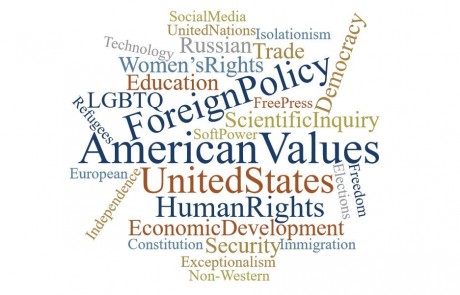
American foreign policy since World War II has relied upon soft power – the ability to influence others based on key human values. Since World War II, the US goal has been to project its image as a nation that is not only strong, but also “good,” drawing on the idea of American Exceptionalism to persuade others that the country is the “shining city on the hill” and a democratic “beacon of freedom” in a troubled world.

Yet U.S. foreign policy has also been guided by national self-interest. This pursuit has at times conflicted with our aspirations and led to less than admirable policies implemented through counter-productive means that diminished America’s standing in the world.

Today a debate over fundamental values rages within the U.S. and abroad. The world’s view of America is no longer favorable. Forty-nine percent of the globe views the United States and President Trump’s “America First” slogan unfavorably. Yet Americans themselves are still admired by fifty-nine percent according to that same Pew “gold standard” poll of international opinion. Can we change this increasingly negative view of our country overall, or if not, will it spread to individual Americans? What can we do to regain the world’s trust?

Barack Obama’s 2008 election was a source of hope at home and overseas. While his administration fell short of expectations, the U.S. did regain and retain much of the international community’s respect. But in the past year, many question if the United States’ foreign policy is guided by its aspirational values.

Are there fundamental human values that all nations and cultures can agree upon or are they idiosyncratic? How are such values interpreted in U.N. documents and organizations of which the U.S. was an instrumental drafter?

Many American aspirational values are enshrined in the Declaration of Independence and U.S. Constitution. Do democracy, human rights, the rejection of tyranny, equality for all, life, liberty and the pursuit of happiness, constitutional government, freedom of the press and worship continue to call for respect domestically and internationally? How can we maintain a free media but deal with concerted efforts to undermine this bedrock of democracy? What about the value and importance of scientific inquiry, which has underpinned economic, health, national security, educational, social and technological foundations of the American success story since before the founding of the Republic?

Finally, can America still be influential on the international stage, or have we yielded that role to others through an “America First” form of isolationism that has diminished US stature with allies to the delight of our competitors and adversaries? What options do we have to navigate today’s unstable world?

Symposium Schedule

Jemez Rooms 231-2

9:00-9:30 Registration

9:30-10:00 Welcome

Dr. Cecilia Cervantes, SFCC Interim President, Welcome on behalf of Santa Fe Community College

The Honorable Peter Ives, Councilor, City of Santa Fe, Welcome on behalf of the City of Santa Fe

Dr. Patricia Kushlis, Welcome and Opening Remarks on behalf of the Santa Fe World Affairs Forum, President

10:00-11:30 Michael Battle, US Ambassador (rtd), The Significance of Multilateral Diplomacy Strengthening Ties with Regional and Continental Organizations: Can US foreign policy be effectively based on isolationism and rational nationalism?

11:30-11:45 Coffee Break

11:45-1:15  Ralph Begleiter, Global Media and International Politics

1:15-2:00  Buffet Lunch

2:00-3:15  Daniel Baer, US Ambassador (rtd) Diplomat in Residence Korbel School, Denver University, The Crisis of American Liberalism is a European Crisis too

3:15-3:30  Coffee Break

3:30-4:45  Laura S H Holgate, US Ambassador (rtd) Science and Leadership in American Foreign Policy

 4:45-5:45  Meet the Speakers Reception, SFCC Board Room, Rm #223

SFCC Lecture Hall – Rm #216

9:00 – 9:15 Registration

9:15 – Welcome, Dr. Patricia H Kushlis, President Santa Fe World Affairs Forum

9:15- 10:45 Dr. Elizabeth Manak, Muslim Values: Political Islam vs. Islamism

10:45-11:00 Coffee Break

11:00-11:45  What ‘They’ Think of Us and Why It Matters,” Foreign Student Panel Discussion chaired by Ralph Begleiter with students from the University of New Mexico, UWC-USA, New Mexico Highlands University and the Santa Fe Community College

11:45-12:30 Buffet Lunch

12:30 – 2:00 Beatrice Camp, “US-China Relations and the Art of the Deal”

2:00- 3:30  Dr. James West, Russia, “Up Off Our Knees:  The Search for a Usable Past for Russia’s Resurgence”

3:30- 3:40 Closing Remarks – Dr. Patricia H Kushlis

The Speakers

Daniel Baer
Daniel BaerAmbassador (rtd), Diplomat in Residence, Josef Korbel School of International Affairs, Denver University. US Ambassador to the Organization for Security and Cooperation in Europe (2013-17)
Topic: “The Crisis of American Liberalism is a European Crisis too”

More About
Michael Battle
Michael BattleUS Ambassador (rtd)
Topic: “The Significance of Multilateral Diplomacy Strengthening Ties with Regional Continental Organizations: Can US foreign policy be effectively based on isolationism and rational nationalism?”

More About
Ralph Begleiter
Ralph BegleiterWorld Affair Correspondent
Topic: “Global Media and International Politics”

More About
Beatrice Camp
Beatrice CampSenior Foreign Service Officer (rtd)
Topic: “US-China Relations and the Art of the Deal”

More About
Laura S. H. Holgate
Laura S. H. HolgateAmbassador (rtd), Senior Nonresident Fellow, Belfer Center for Science and International Affairs,Kennedy School of Government, Harvard University
Topic: “Science and Leadership in American Foreign Policy”

More About
Dr. Elizabeth Manak
Dr. Elizabeth ManakSouth Asia and Nonproliferation Specialist
Topic: “Muslim Values: Political Islam vs. Islamism”

More About
Dr. James L West
Dr. James L WestSpecialist in Pre-Revolutionary Russian Society
Topic: “Up Off Our Knees: The Search for a Usable Past for Russia’s Resurgence”

More About

Cosponsors and Partners

CEUCE EU Logo
Cosponsors
Colorado European Center of Excellence (CEUCE)
Santa Fe Community College (SFCC)
The European Union
World Affairs Council of Albuquerque


Partners

American Association of University Women (AAUW) – Santa Fe Chapter
American Foreign Service Association (AFSA), Washington, DC
Fulbright Association of New Mexico
Global Ties – ABQ
Los Alamos Committee on Arms Control and International Security
New Mexico Highlands University (NMHU)
PDAA: Association for Public Diplomacy Professionals, Washington, DC
Public Diplomacy Council (PDC), Washington, DC
Santa Fe Art Institute (SFAI)
School for Advanced Research (SAR)
United World College (UWC-USA)
University of New Mexico – International Studies Institute (UNM-ISI)
Veterans for Peace the Albuquerque Chapter #63

Donors

Judith and Bill Alger
AAUW-Santa Fe Chapter
Colorado European Union Center of Excellence
David Douglas
Steve Irsik
Viola and Thomas Harrison
Steve Kerchoff
Patricia Kushlis
Arvid and Mary Jo Lundy

Student Scholarship Sponsors

Jane Abbott
American Foreign Service Association, Washington DC
Deborah Cornelius
Evelyn Early
Viola and Tom Harrison
Patricia and Richard Hawkins
International Studies Institute, University of New Mexico
New Mexico Highlands University, Las Vegas, NM
Public Diplomacy Council, Washington, DC
PDAA: Association for Public Diplomacy Professionals, Washington, DC
UWC/USA, Las Vegas, NM

Registration

April 9 & 10
Members:  $95
Non-Members: $120
Students: $60


April 9 Only
Members & Nonmembers: $75


April 10 Only
Members & Nonmembers: $65

Register for the Symposium:


Symposium 2018 Price List


Where

Santa Fe Community College – Jemez Room

From Rodeo Road turn south onto Richards Avenue. At the third roundabout turn into the campus main drive.
The Visitors Parking Lot is to the right as you enter the campus via Richards Ave. (Handicap parking spaces are in the lot to the left.) Enter the administrative building to the left through the courtyard behind the poles flying the US and New Mexico flags. Walk to the end of the main corridor. The Jemez Rooms are next to the cafeteria, before you reach the bookstore.

World Order Under Threat: Protectionism, Nationalism and Extremism

2019-05-01T14:20:34-07:00

April 24 – 25, 2017

Dr. Patricia Kushlis, President, Santa Fe World Affairs Forum; Santa Fe Community College Representative; Javier Gonzales, Mayor of Santa Fe, New Mexico, since 2014, after serving two terms on the City Council. He was the first Hispanic President of the National Association of Counties; Robin Raphel, US Ambassador (rtd) to Tunisia and former Assistant Secretary of State for South and Central Asian Affairs; John Herbst, US Ambassador(rtd) (Uzbekistan and Ukraine), and Director of the Dinu Patriciu Eurasia Center, Atlantic Council; Dr. Raul Gouvea, Professor, International Business and Latin American Management, Anderson School of Management, University of New Mexico; Jerry Pacheco, Executive Director, International Business Accelerator, and international trade columnist & NAFTA specialist, The Albuquerque Journal; Dr. Fernando Lopez-Alves, Professor of Sociology, Global Studies and War & Conflict, University of California at Santa Barbara; Director of Global and International Studies, University of Salamanca; the Interdisciplinary Center for the Study of Politics, Business and Economics, CEMA, Buenos Aire; Dr. Joe Jupille, Associate Professor of Political Science and Faculty Research Associate of the Institute of Behavioral Science, University of Colorado, Boulder; Mary Minow, Library Law Consultant; Advanced Leadership Initiative Fellow, Harvard University; attorney and specialist on disinformation; Ray Rivera, Editor in Chief, Santa Fe New Mexican newspaper.

Summary

The hope in the West for a peaceful world order following the collapse of the Soviet Union has given way in the last years to a stark new reality. The post-Cold War security order has broken down at the same time that we see the fraying of the internal order of most states worldwide. We are looking at growing fragmentation within both individual states and the global community while inequality, retrenchment, protectionism, nationalism, and ideological extremism are on the rise. Twenty-five years ago, we believed major warfare would be highly unlikely; today it is no longer unthinkable. The consequences of new technologies are unclear, and we already seem to be in the early stages of cyber warfare. Inequality of wealth in the West pales in the face of even greater inequalities in the former Communist states of Russia and China, and where that might lead is hard to gauge. The aging of populations in the developed world will put new strains on economic systems and on the young. Many Arab nations are growingly dysfunctional, while magnet states are erecting ever tougher barriers to immigration and the flow of peoples. The temptation to retrench into tribalistic tendencies like populism, economic protectionism, extreme nationalism and fundamentalist beliefs is hard to counter.

With the help of experts in some of these areas, the Santa Fe World Affairs Forum’s 2017 Symposium will discuss these issues in depth in an effort to explore solutions to this increasingly challenging situation. 

(more…)

Crisis in Human Migration: A New World of Walls?

2019-05-01T14:20:34-07:00

April 18-19, 2016

Dr. Demetrios Papademetriou, Distinguished Senior Fellow and President Emeritus, Migration Policy Institute and President MPI Europe;  Joseph C. Wilson IV, US Ambassador (rtd);  Andrew Purvis, former Beirut Managing Editor,UNHCR, and former bureau chief TIME Magazine; Chick Keller, Climate and Botanical Consultant to Pajarito Environmental Educational Center, Los Alamos; William J Garvelink, US Ambassador (rtd); Salvador Gutierrez, Regional Liaison and Policy Officer for Central and North America and the Caribbean, International Organization on Migration; Dr. Dieter Dettke, Adjunct Professor of European Security, Georgetown University and former Director of the Friedrich Ebert Foundation, Washington, D.C; Larry Rasmussen, Reinhold Niebuhr Professor Emeritus of Social Ethics, Union Theological Seminary, New York City and author of Earth-Honoring Faith (Oxford University Press, 2013); Javier Gonzalez, Mayor of Santa Fe, New Mexico

Summary

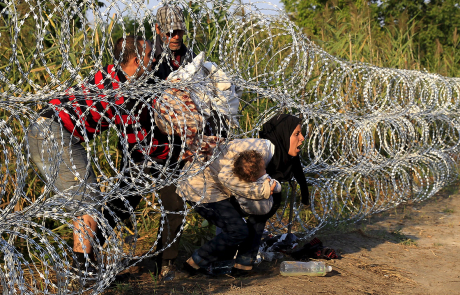
A day does not pass without reports of unprecedented flows of people who have abandoned their homes in hope of better lives in other countries. The most visible movements today are of people from war torn Syria, Iraq and Afghanistan struggling to Turkey and Greece in order to reach European nations where jobs are more plentiful and economies stronger. Elsewhere, Africans, Latin Americans, Southeast Asians and islanders of the Indonesian archipelago, fleeing failing countries, gang warfare, drug cartels and civil wars, also risk death to cross to countries that are closing doors and erecting fences in response to the influx.

The Symposium seeks an understanding of the origins, drivers, and cultural implications behind the news. It will search for explanations to all the complex questions: Who are these refugees?  How does today’s situation compare with human migration flows in the past? How are refugees handled? How many live in camps in neighboring countries, how are those camps organized and funded and how many of the refugees leave legally or illegally for the West?  How real are the claims that terrorists mingle within refugee communities? How do the major refugee organizations determine where refugees are to settle?  What kinds of support do cities and local organizations provide for these newcomers, And, finally, what are the plans for resettling refugees in Santa Fe and Albuquerque – both traditionally refugee-receiving cities.

(more…)

A Climate of Change: the Global Imperative

2019-05-01T14:20:34-07:00

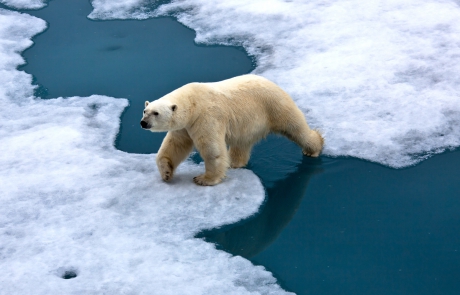
Scientific and anecdotal evidence tell us that the earth’s temperature is warming at rates not experienced in centuries. What exactly does this mean for the planet, for ourselves, for our children, for our children’s children? How can citizens and policy makers be made to understand that we’re all in this together? That means Washington—and Beijing, Berlin, Rio, Delhi and the Pacific Islanders. And loggers in the rain forests of Myanmar and Indonesia. And agribusiness in California. And large corporations headquartered in New York, London, Tokyo and Hong Kong. That means us, here, in New Mexico. (more…)

Talking with Enemies, Cultivating Friends: Diplomacy Revisited

2019-05-01T14:20:34-07:00

“In a world of complex threats, our security and leadership depends on all elements of our power – including strong and principled diplomacy. . .” – President Barack Obama, State of the Union Address, January 28, 2014.

Since 9/11, the Pentagon, the CIA and the NSA have held near total rein over US foreign policy.  But to what avail?  Hugely expensive military interventions in Iraq and Afghanistan have produced neither peace nor tranquility:  those wars (one of which we precipitated) continue.  Moreover, civil wars – the most common ones in the world today – are notoriously difficult to stop through foreign military intervention alone. Electronic eavesdropping and cyber warfare present other challenging and disturbing dimensions: but how much cell-phone snooping is counter-productive? Isolationism – especially in a globalized, high-tech world with porous borders and interrelated economies and serious environmental problems – has also proven bankrupt.

(more…)