
The European Union: From Refugee Crisis To Migration Management
February 28, 2017
Renate Hahlen
 Today, 65 million people are forcibly displaced as refugees, asylum seekers or internally displaced persons worldwide. This figure, the highest number since the end of World War II, results from an increasing number of complex, large and protracted crises worldwide. In addition, many more people are on the move to escape poverty and seek a better life elsewhere. The largest movements of migrants take place within and between developing countries, and most of the forcibly displaced end up in camps in developing countries. Such movements of the displaced, traditionally, have garnered little international attention.
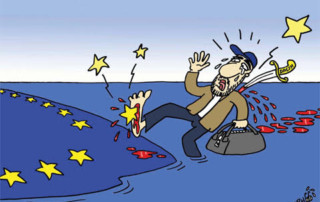
However, that perception rapidly changed in 2014 when desperate Syrian and other refugees and migrants began to move towards the European Union (EU) in large and unprecedented numbers, by land and sea, and in unsafe conditions. Europe, the destination of choice, a continent of permeable borders, desperately struggled to handle the unparalleled situation.
 Dr. Renate Hahlen is minister counselor for development of the European Union Delegation in Washington, DC. The EU has moved rapidly to put order into uncontrolled inflows of people. Innovating practices, regulations and instruments in record time, the EU is addressing the internal and external dimensions of its new, desperate people on the move.
Minister Counselor Hahlen’s presentation is funded in part by the European Union and the Colorado European Union Center of Excellence (CEUCE) at Denver University and the EU Mission to the US. She will also speak at the University of New Mexico’s International Studies Institute on February 27 and will address the Albuquerque Committee on Foreign Relations (ACFR) dinner, February 28. SFWAF members may attend at AFCR member prices. For more information please contact ACFR program chair Bob McGuire or 505-281-1108.
This program will be in the Santa Fe Community College Board Room (room #223).

