About Deepak Maharjan

This author has not yet filled in any details.
So far Deepak Maharjan has created 88 blog entries.

Planning for Resilience: What can be legally done to mitigate disruptive environmental and other severe events and adjust to their impacts?

April 13, 2022

Professor Catherine Banet

The number of severe and sometimes catastrophic disruptive events has been rapidly increasing. Extreme weather events including floods, wildfires, hurricanes, and other natural disasters have become both more frequent and more severe, whilst events such as the COVID-19 pandemic represent a global threat to public health with huge economic effects that recovery packages tried to address.

These disruptive events, alone and in combination, have dramatic consequences on nature, human life, and the economy, calling for urgent action to mitigate their causes and adapt to their impacts.

Dr Banet’s talk is based on a new book for which she is lead co-editor: Resilience in Energy Infrastructure and Natural Resources Law.

Catherine Banet

Catherine Banet (PhD) is Associate Professor at the Scandinavian Institute of Maritime Law, Head of the Department of Energy and Resources Law, University of Oslo, Norway. Her research focuses on renewable energy, support schemes and alternative financing models, energy market design, energy infrastructures regulation, climate change mitigation measures including carbon capture and storage (CCS), offshore wind and hydrogen regulation. She has background from private law practice (Norway, France), the European Commission (DG ENV), U.S. diplomatic mission and academia. She is member of the Advisory Academic Group to the International Bar Association, Section for Energy, Environment and Natural Resources and Infrastructure Law (SEERIL), and Academic Fellow at the Center on Regulation in Europe (CERRE). She is the Chair of the Board of the Norwegian Energy Law Association

The Speaker

Catherine Banet
Catherine BanetAssociate Professor at the Scandinavian Institute of Maritime Law, Head of the Department of Energy and Resources Law, University of Oslo, Norway
Catherine Banet (PhD) is Associate Professor at the Scandinavian Institute of Maritime Law, Head of the Department of Energy and Resources Law, University of Oslo, Norway. Her research focuses on renewable energy, support schemes and alternative financing models, energy market design, energy infrastructures regulation, climate change mitigation measures including carbon capture and storage (CCS), offshore wind and hydrogen regulation. She has background from private law practice (Norway, France), the European Commission (DG ENV), U.S. diplomatic mission and academia. She is member of the Advisory Academic Group to the International Bar Association, Section for Energy, Environment and Natural Resources and Infrastructure Law (SEERIL), and Academic Fellow at the Center on Regulation in Europe (CERRE). She is the Chair of the Board of the Norwegian Energy Law Association

Planning for Resilience: What can be legally done to mitigate disruptive environmental and other severe events and adjust to their impacts?2022-04-11T20:14:08-07:00

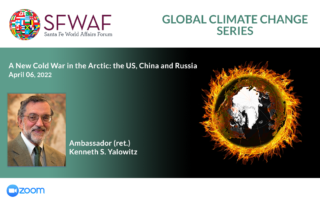
A New Cold War in the Arctic: the US, China and Russia?

April 06, 2022

Ambassador (ret.) Kenneth S. Yalowitz

As US and world attention are riveted on Russia’s invasion of Ukraine, the effects of global warming in the Arctic with respect to US relations with Russia and China based on the need for sustainable economic development and increasing environmental protection have not disappeared. They remain existential problems for the planet. What do the rising temperatures in the Arctic region mean in terms of their outsized significance and in particular their causal effects on rising sea levels and extreme weather events globally? How has the Ukraine war affected cooperation in the Arctic Council and will the Arctic become yet another area where confrontation not cooperation prevail?

Ambassador Yalowitz was a career Foreign Service Officer from 1966-2001 and served twice as U.S. ambassador: to the Republic of Belarus from 1994-1997; and to Georgia from 1998-2001. Other overseas assignments included Moscow (twice) including in 1991 at the time of the breakup of the USSR, The Hague and the US Mission to NATO in Brussels. In 1984, Ambassador Yalowitz received a State Department superior honor award for crisis management in the shootdown of KAL-007. He was chosen for the Ambassador Robert Frasure award for peacemaking and conflict prevention in 2000 for his work to prevent the spillover of the Chechen war into Georgia. In 2009, he was invited to join the American Academy of Diplomacy whose members are former senior US Ambassadors and high-level government officials and in 2011 he was elected to membership in the Council on Foreign Relations.

Following his retirement in 2001 from the Department of State, Ambassador Yalowitz began teaching graduate courses at Georgetown University dealing with Russia’s conflicts with its South Caucasus neighbors. From 2003-12 he directed the Dickey Center for International Understanding at Dartmouth College. During that time, he co-taught courses with faculty members on authoritarianism and democracy in the former USSR and the politics of language in the South Caucasus countries. He then returned to teaching at Georgetown where he was asked to serve as the Director of the Conflict Resolution MA Program from June 30, 2015 to July 1, 2018. Subsequently, he remained an adjunct professor at Georgetown, was the Cyrus Vance Visiting Scholar at Mount Holyoke College in the Spring Term of 2019, and most recently started teaching at Virginia Tech as an adjunct.

His opeds or articles have appeared in the New York Times, Washington Post, International Herald Tribune, Boston Globe, Christian Science Monitor, The National Interest, The American Interest, The Hill, Politico, Newsweek, and Moscow Times amongst others and he is frequently interviewed and quoted. Ambassador Yalowitz is from Chicago (DOB May 28, 1941), graduated from the University of Wisconsin and has an MA, MPhil and Russian Institute Certificate from Columbia University. He speaks Russian.

The Speaker

Kenneth S. Yalowitz
Kenneth S. Yalowitz Ambassador (ret.)
Ambassador (ret.) Kenneth S. Yalowitz was a career Foreign Service Officer from 1966-2001 and served twice as U.S. ambassador: to the Republic of Belarus from 1994-1997; and to Georgia from 1998-2001. Other overseas assignments included Moscow (twice) including in 1991 at the time of the breakup of the USSR, The Hague and the US Mission to NATO in Brussels. In 1984, Ambassador Yalowitz received a State Department superior honor award for crisis management in the shootdown of KAL-007. He was chosen for the Ambassador Robert Frasure award for peacemaking and conflict prevention in 2000 for his work to prevent the spillover of the Chechen war into Georgia. In 2009, he was invited to join the American Academy of Diplomacy whose members are former senior US Ambassadors and high-level government officials and in 2011 he was elected to membership in the Council on Foreign Relations.

Following his retirement in 2001 from the Department of State, Ambassador Yalowitz began teaching graduate courses at Georgetown University dealing with Russia’s conflicts with its South Caucasus neighbors. From 2003-12 he directed the Dickey Center for International Understanding at Dartmouth College. During that time, he co-taught courses with faculty members on authoritarianism and democracy in the former USSR and the politics of language in the South Caucasus countries. He then returned to teaching at Georgetown where he was asked to serve as the Director of the Conflict Resolution MA Program from June 30, 2015 to July 1, 2018. Subsequently, he remained an adjunct professor at Georgetown, was the Cyrus Vance Visiting Scholar at Mount Holyoke College in the Spring Term of 2019, and most recently started teaching at Virginia Tech as an adjunct.

His opeds or articles have appeared in the New York Times, Washington Post, International Herald Tribune, Boston Globe, Christian Science Monitor, The National Interest, The American Interest, The Hill, Politico, Newsweek, and Moscow Times amongst others and he is frequently interviewed and quoted. Ambassador Yalowitz is from Chicago (DOB May 28, 1941), graduated from the University of Wisconsin and has an MA, MPhil and Russian Institute Certificate from Columbia University. He speaks Russian.

A New Cold War in the Arctic: the US, China and Russia?2022-04-09T20:07:53-07:00

The Intent and Reality of Foreign Assistance to Afghanistan: Experience from Obama’s Surge

March 09, 2022

Rebecca Black

The U.S. government spent $145 billion to rebuild and develop Afghanistan over the past 20 years. Funds were implemented by a dozen USG agencies including USAID, a major player in supporting a range of activities, from building roads and power plants to improving education and health, governance, and income generation. Themes of democracy and women’s empowerment played alongside counterinsurgency and stability. Funding was big and pressure strong to deliver results in a country with diverse cultures and geography, and limited access due to the nature of war.

Rebecca Black served 25 years as a Foreign Service Officer with USAID, achieving the rank of Minister Counselor in the Senior Foreign Service. She most recently served as USAID Mission Director for Cambodia and for Mali, managing a diverse portfolio including health, education, agriculture, and governance.

Ms. Black served as the Deputy Mission Director for USAID Afghanistan and as economic and urban environment program director in India, South Africa, and Poland. Ms. Black began her professional career in community economic development in Boston, Massachusetts, following completion of a master degree from the Massachusetts Institute of Technology. Ms. Black now lives in New Mexico, working occasionally on international development assignments, and volunteer engagements.

The Speaker

US Senior Foreign Service Officer, USAID (rtd)
Rebecca Black served 25 years as a Foreign Service Officer with USAID, achieving the rank of Minister Counselor in the Senior Foreign Service. She most recently served as USAID Mission Director for Cambodia and for Mali, managing a diverse portfolio including health, education, agriculture, and governance.

Ms. Black served as the Deputy Mission Director for USAID Afghanistan and as economic and urban environment program director in India, South Africa, and Poland. Ms. Black began her professional career in community economic development in Boston, Massachusetts, following completion of a master degree from the Massachusetts Institute of Technology. Ms. Black now lives in New Mexico, working occasionally on international development assignments, and volunteer engagements.

The Intent and Reality of Foreign Assistance to Afghanistan: Experience from Obama’s Surge2022-03-05T00:13:21-07:00

Afghanistan’s Cycle of Historical Repetition

March 02, 2022

Paul Cruickshank

A personal reflection based on nearly 15 years’ experience in Afghanistan; a review of Afghan history, especially regarding the 21st Century, and its ethnic and political challenges; how such challenges led to the need for humanitarian and development assistance over the last 20 years, and in particular the need for urgent assistance to address the ongoing humanitarian crisis; and an overview of how the international community, including the United Nations, has been operating, and continues to operate, across the country in support of the Afghan people.

 Paul-CruickshankPaul Cruickshank comes from a military background, having served with the British Army for 20 years. He is a graduate of the British Army Command and Staff College (1994-1995), and was later appointed Member of the British Empire (MBE) by Queen Elizabeth II in 1999, for his contribution to strategic military planning for peace support operations in the Balkans. His last deployment in the army was to Afghanistan at the end of 2001 as part of the international effort to remove the Taliban regime and commence reconstruction across the country.

Paul joined the UN in Afghanistan in 2002 and helped set up, plan and implement the Afghan Disarmament, Demobilisation and Reintegration (DDR) programme. At the end of disarmament and demobilization, he moved to Indonesia (Banda Aceh) to set up and manage support to the Indonesian Government’s response to the 2004 tsunami. In 2006, Paul was posted to Iraq as Senior Advisor on Security Sector Reform. In 2009, he moved to Kosovo to manage the Support to Security Sector Reform programme, before returning to Afghanistan in 2010 to set up and run UK DFID’s M&E programme in Helmand province. He re-joined the UN in early 2011, before being posted to South Sudan as Director and Representative in early 2015. Paul returned to Afghanistan in May 2017 as UNOPS’ Director & Representative, a position he held until retiring from the UN at the end of 2021.

Paul is now the founder and CEO of Fillan Rose Ltd, a discreet management consultancy seeking, in both the public and private sectors, to apply lessons learnt over the last 20 years so that more can be done with less, and all can be done better.

The Speaker

Paul Cruickshank
Paul CruickshankFounder and CEO of Fillan Rose Ltd
Paul Cruickshank comes from a military background, having served with the British Army for 20 years. He is a graduate of the British Army Command and Staff College (1994-1995), and was later appointed Member of the British Empire (MBE) by Queen Elizabeth II in 1999, for his contribution to strategic military planning for peace support operations in the Balkans. His last deployment in the army was to Afghanistan at the end of 2001 as part of the international effort to remove the Taliban regime and commence reconstruction across the country.

Paul joined the UN in Afghanistan in 2002 and helped set up, plan and implement the Afghan Disarmament, Demobilisation and Reintegration (DDR) programme. At the end of disarmament and demobilization, he moved to Indonesia (Banda Aceh) to set up and manage support to the Indonesian Government’s response to the 2004 tsunami. In 2006, Paul was posted to Iraq as Senior Advisor on Security Sector Reform. In 2009, he moved to Kosovo to manage the Support to Security Sector Reform programme, before returning to Afghanistan in 2010 to set up and run UK DFID’s M&E programme in Helmand province. He re-joined the UN in early 2011, before being posted to South Sudan as Director and Representative in early 2015. Paul returned to Afghanistan in May 2017 as UNOPS’ Director & Representative, a position he held until retiring from the UN at the end of 2021.

Paul is now the founder and CEO of Fillan Rose Ltd, a discreet management consultancy seeking, in both the public and private sectors, to apply lessons learnt over the last 20 years so that more can be done with less, and all can be done better.

Afghanistan’s Cycle of Historical Repetition2022-03-04T22:13:04-07:00

Taliban In Afghanistan: ​A Review Six Months Since Take-Over

February 16, 2022

Dr. Emile Nakhleh

Once the US completed the withdrawal of all American military forces and civilian personnel from Afghanistan on August 30,2022, the Taliban not only managed to forge a strategic partnership with the large and influential Haqqani network but was confronted by other challengers in this complex Afghan mosaic. All are Islamic terrorist groups operating within the “new” Afghanistan.

Who are these groups? Where are they based? Which are the most important? Do they have ties to the global Al’Qaida and ISIS Central organizations – and if so which ones do? How do they interact with the Taliban and each other? What are the differences, similarities and the alliances forged between them now that the US is gone? How do operate? What are their short and long term goals and their operational capabilities and, as a consequence, what kind of threats do they and will they likely present to the US? Will the US be able to track their activities without having “boots on the ground?”

This is the second webinar in our Afghanistan in the Aftermath series which we will be holding throughout February and part of March 2022 on Wednesdays from 12:30-1:45.

Dr. Nakhleh spoke most recently to the Santa Fe World Affairs Forum on Terrorism and the Middle East September 2016. It is a pleasure to welcome him back.

Dr. Emile Nakhleh, is a retired CIA Senior Intelligence Service Officer and founding director of CIA’s Political Islam Strategic Analysis Program Office. He currently serves as Research Professor and Director of the Global and National Security Policy Institute (GNSPI) at the University of New Mexico. He is a National Intelligence Council/IC Associate and a member of the Council on Foreign Relations. Since retiring from the US Government in 2006, he has consulted on national security issues, particularly Islamic radicalization, terrorism, and the Arab states of the Middle East. He has published frequently on the “Arab Spring” in the Financial Times and Cipher Brief.

He holds a Ph.D. from the American University, Washington, D.C., in International Relations, an M.A. from Georgetown University in Political Science, and a B.A. from Saint John’s University, Minnesota, in Political Science. He is the author of numerous academic books and scholarly articles. He is currently President of the World Affairs Council – Albuquerque. He and his wife, Ilonka Lessnau Nakhleh, live in Albuquerque, NM.

The Speaker

Dr. Emile Nakhleh
Dr. Emile NakhlehCIA Senior Intelligence Service Officer and founding director of CIA’s Political Islam Strategic Analysis Program Office, Research Professor and Director of the Global and National Security Policy Institute (GNSPI) at the University of New Mexico
Dr. Emile Nakhleh is a retired CIA Senior Intelligence Service Officer and founding director of CIA’s Political Islam Strategic Analysis Program Office. He currently serves as Research Professor and Director of the Global and National Security Policy Institute (GNSPI) at the University of New Mexico. He is a National Intelligence Council/IC Associate and a member of the Council on Foreign Relations. Since retiring from the US Government in 2006, he has consulted on national security issues, particularly Islamic radicalization, terrorism, and the Arab states of the Middle East. He has published frequently on the “Arab Spring” in the Financial Times and Cipher Brief.

He holds a Ph.D. from the American University, Washington, D.C., in International Relations, an M.A. from Georgetown University in Political Science, and a B.A. from Saint John’s University, Minnesota, in Political Science. He is the author of numerous academic books and scholarly articles. He is currently President of the World Affairs Council – Albuquerque. He and his wife, Ilonka Lessnau Nakhleh, live in Albuquerque, NM.

Taliban In Afghanistan: ​A Review Six Months Since Take-Over2022-02-19T09:51:00-07:00

Union Humanitarian Aid in Afghanistan: before and after the US withdrawal

February 09, 2022

Raffaella Iodice

Although the US completed withdrawal of all its military forces and civilian personnel from Afghanistan on August 30,2022, the European Union was also involved in the larger evacuation multinational operation that took place at the Hamid Karzai International Airport in Kabul in August. Since then, the EU has continued to contribute humanitarian aid to Afghanis still living in the country. Raffaella Iodice not only was part of the EU evacuation endeavours in August, but subsequently participated in Doha-EU negotiations as well as in talks with partners and the Talib in Kabul in December to help facilitate European humanitarian aid reach the Afghanis who need it most. Ms Iodice, an internationally respected specialist of development in war-torn countries, is currently based at the European Commission in Brussels from where she will be conducting this webinar. In it, she will share some of the EU experience gained and lessons learned as a part of her work in and on Afghanistan.

This is the first webinar in our Afghanistan in the Aftermath series which we will be holding throughout February and part of March 2022 on Wednesdays from 12:30-1:45

We appreciate the European Commission’s facilitation in making this first webinar in the series possible.

Raffaella Iodice presently serves as Head of Unit for “Asia, Latin America, Caribbean and Pacific” and Deputy Director at the Directorate General for European Civil Protection and Humanitarian Aid Operations (ECHO) after serving as Head of the “Middle East/Gulf, South Asia and Central Asia” at the European Commission “Development and International Cooperation” department (IN TPA).

Born in Italy, she left her home just after graduating from high school, to attend the university in Brussels (ULB). Just after her final University degree, in 1991, she joined the European Commission. Over the years, Raffaella has become an internationally respected specialist of development, particularly in the areas of war-torn countries and the Middle East. She has held posts in Palestine during the second Intifada (from 2002 to 2007), where she was in charge of development cooperation activities and relations with the Palestinian Authority, and in Egypt (from end of 2007 to end 2011), where she managed political and development relationships with the government. She lived in Cairo during the Tahir revolution and once back to Brussels at the end of 2011, she has been actively involved in all EU activities in the region during the so-called Arab Spring. She has also served as Head of Unit for the Mediterranean countries with frequent travels to Libya, Syria, Lebanon, Morocco, Palestine…

In her capacity, she is now actively involved also in Afghanistan, Uzbekistan, Pakistan and Iraq, countries she regularly visits.
She commands several languages. Among them: French, English, Spanish, German, Hebrew and some Arabic.

The Speaker

Raffaella Iodice
Raffaella Iodice
Raffaella Iodice presently serves as Head of Unit for “Asia, Latin America, Caribbean and Pacific” and Deputy Director at the Directorate General for European Civil Protection and Humanitarian Aid Operations (ECHO) after serving as Head of the “Middle East/Gulf, South Asia and Central Asia” at the European Commission “Development and International Cooperation” department (IN TPA).

Born in Italy, she left her home just after graduating from high school, to attend the university in Brussels (ULB). Just after her final University degree, in 1991, she joined the European Commission. Over the years, Raffaella has become an internationally respected specialist of development, particularly in the areas of war-torn countries and the Middle East. She has held posts in Palestine during the second Intifada (from 2002 to 2007), where she was in charge of development cooperation activities and relations with the Palestinian Authority, and in Egypt (from end of 2007 to end 2011), where she managed political and development relationships with the government. She lived in Cairo during the Tahir revolution and once back to Brussels at the end of 2011, she has been actively involved in all EU activities in the region during the so-called Arab Spring. She has also served as Head of Unit for the Mediterranean countries with frequent travels to Libya, Syria, Lebanon, Morocco, Palestine…

In her capacity, she is now actively involved also in Afghanistan, Uzbekistan, Pakistan and Iraq, countries she regularly visits.

She commands several languages. Among them: French, English, Spanish, German, Hebrew and some Arabic.

Union Humanitarian Aid in Afghanistan: before and after the US withdrawal2022-02-19T08:48:27-07:00
Load More Programs